
Pulse: What Your Heart Is Trying to Tell You
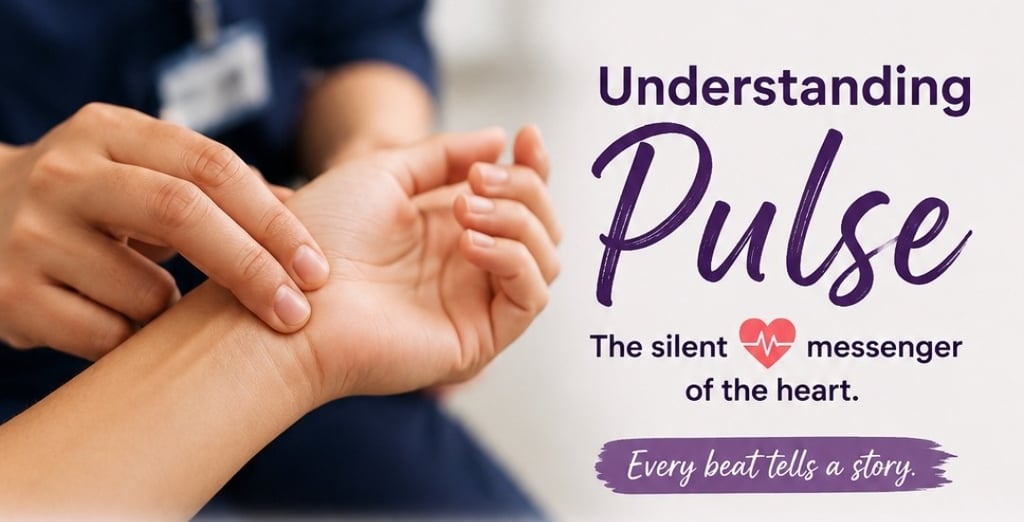
❤️ UNDERSTANDING PULSE Every heartbeat tells a story. Your pulse is the wave of blood you feel each time your heart beats. By checking the pulse at the wrist or neck, nurses can learn a lot about a person's health. 🔹 Normal adult pulse: 60–100 beats per minute 🔹 Exercise, fever, stress, and pain can increase pulse rate 🔹 Changes in pulse may be an early sign of illness 🔹 Common pulse sites include the wrist, neck, arm, ankle, and foot Pulse assessment is one of the simplest but most important nursing skills. Sometimes, a changing pulse is the first clue that the body needs help. 📚 Learn. Understand. Care. 🌐 www.medicsimplified.com #Medicsimplified #Pulse #VitalSigns #NursingEducation #StudentNurse #NurseLife #ClinicalSkills #HealthcareEducation #FutureNurse #Bodyland
Olawale Richard Akinmade
5/31/20262 min read
Pulse: What Your Heart Is Trying to Tell You
Have you ever placed your fingers on your wrist or neck and felt a gentle, steady beat?
That's your pulse.
Your pulse is simply the feeling of blood moving through your arteries every time your heart beats. Think of it as your heart's way of saying, "I'm here, and I'm working."
Every beat sends blood carrying oxygen and nutrients to every part of your body. Because of this, your pulse can reveal a lot about what's happening inside you.
For most adults, a normal resting pulse is between 60 and 100 beats per minute. If you've just climbed stairs, exercised, felt anxious, or received exciting news, your pulse may become faster. When you're relaxed or sleeping, it usually slows down.
As nurses, checking a patient's pulse is about more than counting beats. We pay attention to whether the pulse feels regular or irregular, strong or weak, fast or slow. These small details can provide important clues about a person's health.
For example, a rapid pulse may occur during fever, pain, dehydration, anxiety, or infection. A slow pulse may be normal in athletes, but in some situations it can indicate a medical problem. An irregular pulse can sometimes suggest an underlying heart rhythm disorder.
The pulse can be checked at several places in the body. The most common site is the wrist, known as the radial pulse. Other pulse points include the neck, arm, groin, behind the knee, and the foot.
One of the remarkable things about the pulse is that it often changes before a patient says they feel unwell. A rising pulse may be an early warning sign that the body is under stress. This is why nurses routinely monitor pulse as part of patient assessment.
The next time you feel your pulse, remember that you are feeling the rhythm of life itself. Each beat is a reminder that your heart is tirelessly working day and night to keep every cell in your body alive.
A pulse is more than a number. It is a story—one heartbeat at a time.